
Acronyms are condensed linguistic tools that transform long phrases into compact, memorable units. Unlike general abbreviations, which simply shorten words (like “approx.” for approximately), acronyms are formed from initial letters and often pronounced as words (like “NATO”), while initialisms (like “FYI”) are spelled out letter by letter.
In today’s fast-paced communication landscape—spanning texting, workplace messaging, online forums, and academic discussions—acronyms act as efficiency boosters.
They reduce typing effort, speed up comprehension, and signal belonging to specific communities or domains.
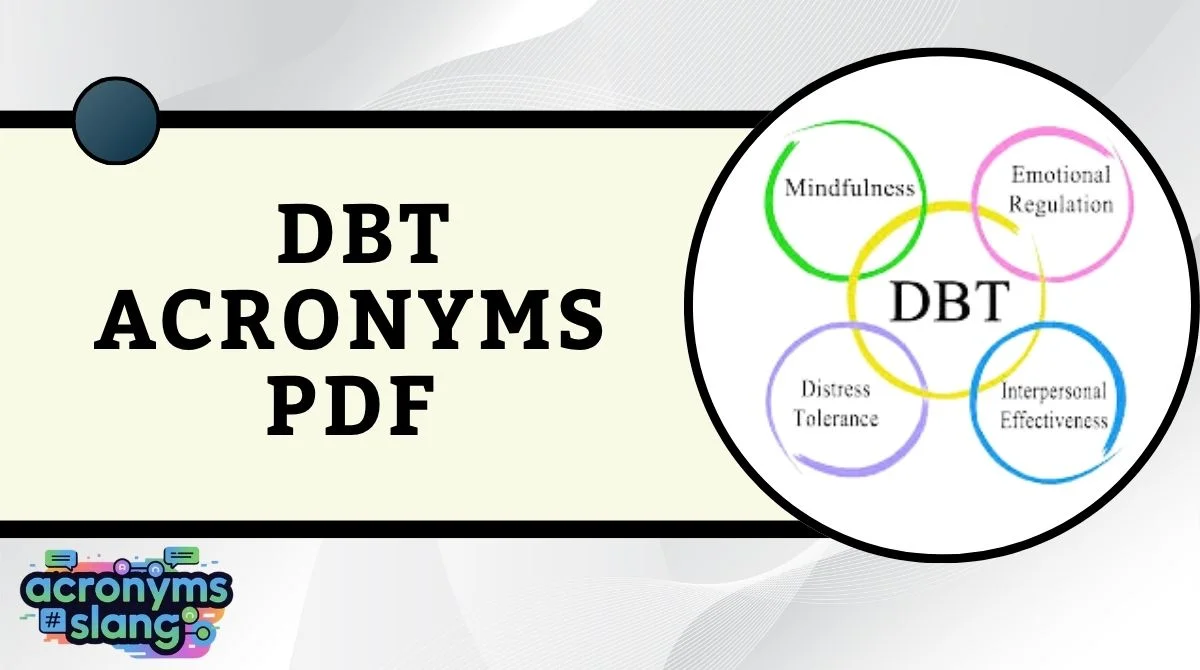
The keyword “157+ DBT acronyms pdf” fits into this broader trend by targeting a specialized category: structured, domain-based acronyms (often used in psychology, therapy contexts like Dialectical Behavior Therapy, or even digital communication depending on context).
These collections are valuable not just as lists but as tools for understanding tone, context, and intent.
Acronyms are not just shortcuts—they are social signals. Using them effectively requires understanding when, where, and how they shape meaning.
Quick Reference Table
| Acronym | Full Form | Meaning | Tone | Common Usage Context |
|---|---|---|---|---|
| DBT | Dialectical Behavior Therapy | A type of therapy | Professional | Psychology, Healthcare |
| IMO | In My Opinion | Personal viewpoint | Casual | Social media, texting |
| FYI | For Your Information | Sharing info | Neutral | Workplace, emails |
| BRB | Be Right Back | Temporary absence | Casual | Chatting, gaming |
| IDK | I Don’t Know | Uncertainty | Casual | Texting |
| ASAP | As Soon As Possible | Urgency | Semi-formal | Work, emails |
| TBH | To Be Honest | Honest opinion | Casual | Social media |
| DM | Direct Message | Private message | Neutral | Social media |
| IRL | In Real Life | Offline world | Casual | Internet culture |
| ETA | Estimated Time of Arrival | Time estimate | Professional | Logistics |
| BTW | By The Way | Adding info | Casual | Chatting |
| TMI | Too Much Information | Oversharing | Playful | Social media |
| NVM | Never Mind | Disregard | Casual | Messaging |
| FAQ | Frequently Asked Questions | Common queries | Neutral | Websites |
DBT
Full Form: Dialectical Behavior Therapy
A structured therapeutic approach focused on emotional regulation and coping strategies.
Where It’s Commonly Used: Psychology, counseling sessions, academic discussions
Tone: Professional
Example in Text Message: “My therapist suggested DBT techniques for stress.”
Similar Acronyms: CBT, PTSD
IMO
Full Form: In My Opinion
Used to express a personal viewpoint without sounding overly assertive.
Where It’s Commonly Used: Social media, forums
Tone: Casual
Example: “IMO, this movie was better than the first one.”
Similar Acronyms: IMHO, TBH
FYI
Full Form: For Your Information
Signals that information is being shared without requiring action.
Where It’s Commonly Used: Emails, workplace chats
Tone: Neutral
Example: “FYI, the meeting has been moved to 3 PM.”
Similar Acronyms: NFYI
BRB
Full Form: Be Right Back
Indicates a short absence during conversation.
Where It’s Commonly Used: Chatting, gaming
Tone: Casual
Example: “BRB, someone’s at the door.”
Similar Acronyms: AFK
IDK
Full Form: I Don’t Know
Expresses uncertainty or lack of information.
Where It’s Commonly Used: Texting, casual chat
Tone: Casual
Example: “IDK what time it starts.”
Similar Acronyms: IDC
ASAP
Full Form: As Soon As Possible
Conveys urgency in completing a task.
Where It’s Commonly Used: Work emails, instructions
Tone: Semi-formal
Example: “Please send the report ASAP.”
Similar Acronyms: EOD
TBH
Full Form: To Be Honest
Introduces a candid or slightly blunt opinion.
Where It’s Commonly Used: Social media, texting
Tone: Casual
Example: “TBH, I didn’t enjoy the event.”
Similar Acronyms: IMO
DM
Full Form: Direct Message
Refers to private communication between users.
Where It’s Commonly Used: Social platforms
Tone: Neutral
Example: “DM me the details.”
Similar Acronyms: PM
IRL
Full Form: In Real Life
Distinguishes offline experiences from online ones.
Where It’s Commonly Used: Internet culture
Tone: Casual
Example: “We should meet IRL sometime.”
Similar Acronyms: AFK
ETA
Full Form: Estimated Time of Arrival
Provides a projected arrival time.
Where It’s Commonly Used: Logistics, travel
Tone: Professional
Example: “ETA is 20 minutes.”
Similar Acronyms: ETD
BTW
Full Form: By The Way
Adds extra information casually.
Where It’s Commonly Used: Texting
Tone: Casual
Example: “BTW, I saw your friend yesterday.”
Similar Acronyms: BTD
TMI
Full Form: Too Much Information
Used when someone overshares.
Where It’s Commonly Used: Informal chats
Tone: Playful
Example: “TMI, I didn’t need to know that!”
Similar Acronyms: NSFW
NVM
Full Form: Never Mind
Cancels or retracts a previous statement.
Where It’s Commonly Used: Messaging
Tone: Casual
Example: “NVM, I figured it out.”
Similar Acronyms: NM
FAQ
Full Form: Frequently Asked Questions
A collection of common inquiries and answers.
Where It’s Commonly Used: Websites, documentation
Tone: Neutral
Example: “Check the FAQ section for details.”
Similar Acronyms: Q&A
Acronyms vs Abbreviations vs Initialisms
Acronyms form pronounceable words (NASA), while initialisms require spelling each letter (FBI). Abbreviations simply shorten words without forming new linguistic units (Dr., etc.). The key difference lies in pronunciation and structure, not just length.
Common Mistakes with Acronyms
Many users insert acronyms into formal writing where clarity is essential, leading to confusion. Another issue is assuming universal understanding—what’s obvious in one culture or field may be obscure elsewhere. Overusing acronyms can make communication feel robotic or exclusionary. Tone misinterpretation is also common; for instance, “OK” vs “K” can carry very different emotional weight.
Acronym Usage Guide
In professional emails, limit acronyms to widely recognized ones like FYI or ASAP. In academic writing, define acronyms at first mention. Texting allows more flexibility, encouraging casual forms like IDK or BRB. In international communication, avoid region-specific acronyms unless you’re sure the audience understands them.
Practice Section
Fill in the blanks
- I’ll call you ___ (Be Right Back).
- ___, the meeting is canceled.
- I ___ what you mean.
- Send it ___ please.
- ___, I think you’re right.
- That’s ___ information!
- Let’s meet ___ tomorrow.
- ___ me the details.
- Check the ___ page.
- ___, ignore my last message.
Multiple Choice
- ASAP means:
a) Later
b) Urgently ✅
c) Never - IDK expresses:
a) Certainty
b) Confusion
c) Lack of knowledge ✅ - FYI is mostly:
a) Command
b) Informative ✅
c) Emotional - BRB indicates:
a) Leaving permanently
b) Temporary absence ✅
c) Arrival - TMI means:
a) Not enough info
b) Oversharing ✅
c) Formal tone
Rewrite Using Acronyms
- I will be right back → BRB
- For your information → FYI
- I do not know → IDK
- As soon as possible → ASAP
- By the way → BTW
FAQs
What are DBT acronyms used for?
They are commonly used in therapy, communication, and structured note-taking systems.
Are acronyms suitable for formal writing?
Only when widely recognized or clearly defined first.
What’s the difference between DBT and CBT?
Both are therapy types, but DBT focuses more on emotional regulation.
Why do people use acronyms in texting?
They save time and create conversational efficiency.
Can acronyms cause misunderstanding?
Yes, especially across cultures or professional fields.
Conclusion
Acronyms are powerful linguistic shortcuts, but their effectiveness depends on context, audience, and tone awareness.
Whether in therapy discussions like DBT, workplace communication, or casual texting, the key is balance—use them to enhance clarity, not replace it.